
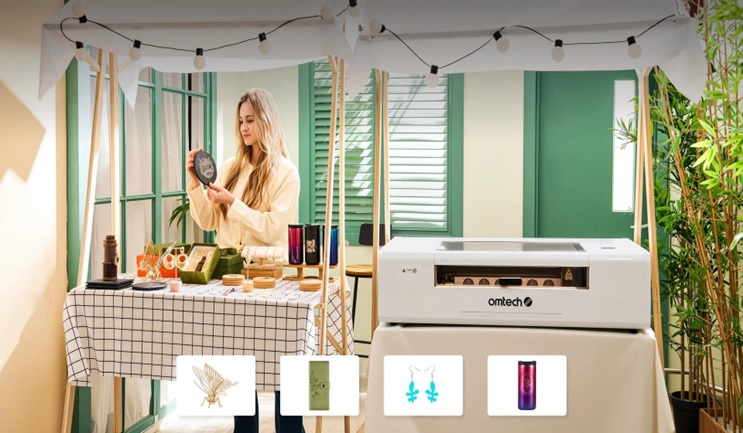
When school districts, Career and Technical Education (CTE) programs, and university engineering labs first decide to introduce digital fabrication to students, the initial purchase is almost always a balancing act between safety compliance and strict budget limits. For hundreds of schools across the United States, this calculus leads them directly to OMTech. Our enclosed desktop models, like the OMTech Polar and Pronto series, have become staples in American classrooms because they offer a highly affordable, fully enclosed Class 1 laser experience that fits perfectly on a standard school lab bench.
However, a recurring phenomenon happens within school districts nationwide: Schools frequently “outgrow” their initial OMTech setup much faster than their five-year technology plans anticipated. But here is the twist: outgrowing a machine isn’t a failure of the hardware—it is a direct symptom of classroom success.
The Bottleneck of Enthusiasm
The primary reason schools outgrow a standard desktop CO2 laser cutter (typically a 12″ times 20″ bed with 50W of power) is sheer user volume. Initially, a teacher might plan to use the laser cutter for a single 9th-grade STEM elective. But within one semester, word spreads. Suddenly, the woodworking class wants to engrave custom cabinetry, the theater department needs to cut intricate acrylic props for the spring play, and the robotics team is waiting in line to prototype custom chassis plates.
When thirty students in a 45-minute class period all need to run a 5-minute cut, a massive bottleneck forms. The beauty of the OMTech ecosystem is that schools aren’t abandoning the brand when this happens; they are diversifying it. Districts are realizing they can buy three industrial-grade OMTech Cabinet CO2 Lasers (such as our 60W or 80W mid-size units with 20″ times 28″ beds) for the exact price of one heavily marketed, proprietary “educational-only” competitor machine. This multiplies student access points by three without blowing the Perkins V grant budget.
Moving from Hobby Materials to True Engineering
A desktop laser is fantastic for cutting 1/8″ Baltic birch plywood, cardboard models, and thin acrylic tags. However, as high school students progress into advanced CTE pathways, engineering design, or dual-enrollment college courses, their material demands change drastically.
High school seniors and trade students quickly push past the limits of desktop machines. They need to cut through 1/2″ thick hardwood for structural assemblies, engrave large architectural scale models, or etch barcodes into heavy tool steel components. Because OMTech isn’t just a desktop hobby brand, schools don’t have to switch vendors or learn entirely new software platforms when they outgrow their entry-level units. A school can seamlessly scale up to our High-Power CO2 Autofocus Cabinets (up to 150W) or introduce our Galvo Fiber Lasers for industrial high-speed metal marking, utilizing the exact same LightBurn software workflow students already mastered on day one.
The Shift to Commercial-Grade Workflows
Many educational-only laser brands isolate students inside simplified, “app-based” cloud ecosystems. While this is easy for middle schoolers, it creates a massive skills gap when students enter the workforce or higher education. When schools realize their advanced students need to learn real-world manufacturing workflows, they outgrow the “gadget” lasers and look for industrial-grade controllers.
Industry doesn’t use cloud apps to run million-dollar machines; they use robust offline controllers and standard vector processing pipelines. OMTech’s larger cabinet systems utilize industry-standard Ruida controllers and mechanical rails. When a student learns how to set focal lengths, adjust air assist pressure, and optimize layer settings on an OMTech 80W cabinet, they are learning the exact fundamental mechanics used in commercial manufacturing facilities worldwide.
Designing a Future-Proof Laser Fleet
If your school is preparing to invest in laser technology—or if you are a district CTE director mapping out funds for the next academic year—the goal should be building a scalable fleet rather than buying a single, restrictive “silver bullet” machine. Instead of buying one hyper-expensive, locked-down desktop unit that your students will outgrow by winter break, consider a tiered deployment strategy across your district.
- The Entry Layer: Place enclosed OMTech Polar (55W) units in middle schools or introductory labs for rapid, safe, and intuitive vector design training.
- The Production Layer: Equip your high school D&T shops and makerspaces with OMTech 60W to 100W Cabinet Lasers to handle large-scale projects, thick material cutting, and high-volume class periods.
- The Advanced Layer: Provide your vocational, welding, and advanced engineering labs with an OMTech Fiber Laser to teach industrial metal serialization, tooling marks, and manufacturing automation.
By partnering with a brand that spans from the desktop to the factory floor, your school will never find itself trapped by its own success. When your students outgrow their first machine, the next step up is already built into the family.